


 Stefani HavelThe Client Conversion Queen™
The CONVERT Method™ · Client Conversion Guide
7 Stops · 1 Destination
A clear sales process gives you a route to follow. The Client Conversion Guide walks all seven stops of CONVERT — from opening the conversation to staying connected after the client gets started — with the exact words to say at each one.
The full guide is a VIP student resource. Stefani hands the unlock code out in class — if you're one of her students, you already have it.
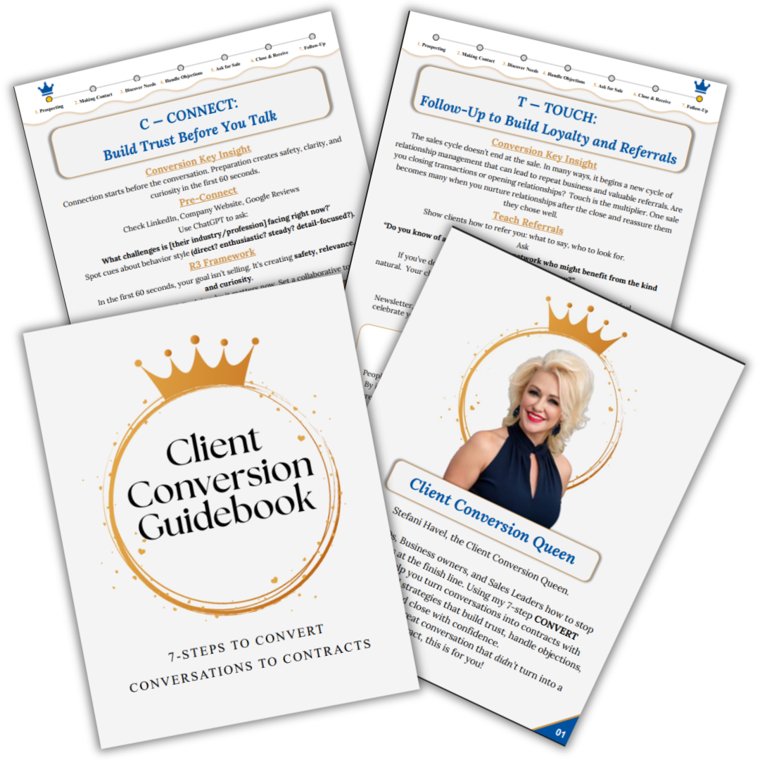
Inside the Guide
Use this guide before a call to prepare and afterward to notice what went well and where you need more practice. You can return to an earlier stop whenever you need to understand more.
Why a route beats a script — and how to be warm, professional, and clear about the next step without pretending to be someone else.
Seven stops. One destination. You are the GPS; your client is the driver — the route at a glance before you go deep.
Before, during, and after the conversation — plus the Route Check: a seven-question review of your process after every call.
A two-minute pre-call routine — Name it, See it, State it, Frame it, Own it — and how to set your pace and tone.
Each stop gets its destination, the exact words to say, the GPS thinking behind it, a key insight, and a practice rep.
A bookkeeper uses the route — all seven stops in one real-feeling conversation, start to finish.
Your plan for the week: three actions to practice, one conversation to review, and a completed example to model yours on.
The CONVERT Accelerator, the CONVERT Community (coming soon), and how to book a Sales Mapping Call when you want a guide beside you.
The Route
Each stop gives you information you need for the next one. If something is unclear, return to the stop where you need to learn more. The route guides your conversation; the client chooses whether to move forward.
You Are Here
Begin by making the person feel welcome. Explain what you will cover and make room for their questions.
Read the Road
Notice what the person says, what they repeat, and where they want more explanation.
Map the Route
Before you recommend a service, understand where the client is now and what they want to change.
Confirm the Destination
Say back what you understood so the client can confirm it or correct it.
Make the Turn
Explain the offer that fits what the client told you. Then ask whether they would like to move forward.
Arriving
After the client says yes, confirm the agreement, payment arrangements, and first step.
The Next Trip
Touch keeps the relationship going — a clear reason to continue the conversation, and introductions made easier when they are a good fit.
Who It's For
You can know your work well and still feel unsure about what to say during a sales conversation.
You may have a good discussion, explain your service, and leave without knowing what happens next.
“You do not need a bigger personality to lead a useful sales conversation. You need a process you understand and practice.”
VIP Student Resource
Stefani hands this code out to her VIP students. Type it below to unlock the full Client Conversion Guide — all 24 pages and the printable PDF.
Not a VIP student yet? Book a free Sales Mapping Call and ask Stefani about the class.
The Full Guide · Unlocked
Your route map for clear sales conversations and confident next steps. Download the printable PDF ↓
Welcome

You can know your work well and still feel unsure about what to say during a sales conversation. You may have a good discussion, explain your service, and leave without knowing what happens next.
CONVERT gives you seven stops to follow. Each stop has a purpose, from opening the conversation to staying connected after the client gets started.
Think of yourself as the GPS. You ask where the client is now, learn where they want to go, and explain a route that may fit. The client stays in the driver's seat and chooses their next step.
The destination is a clear decision about whether working together fits the client's needs. When it does, we make the next steps clear. When it does not, we respect that decision.
Use this guide before a call to prepare and afterward to notice what went well and where you need more practice. You can return to an earlier stop whenever you need to understand more.
With confidence, — Stefani
Mindset and Structure
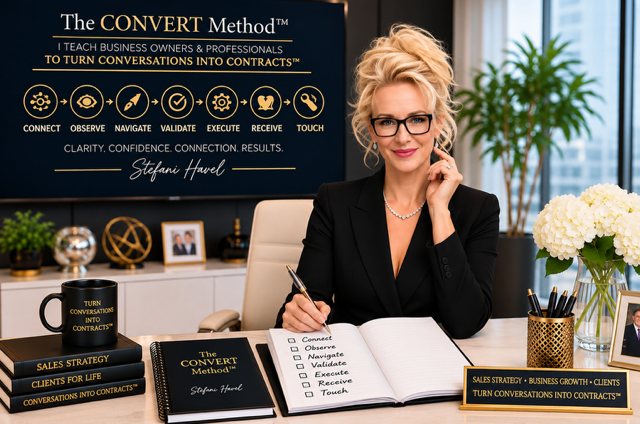
Being friendly makes it easier to begin a conversation. A clear process gives that conversation direction. You listen, ask questions, explain what fits, and invite the client to decide. You can do this in your own words without becoming pushy or pretending to be someone else.
You understand the purpose of each stop and what you need to learn.
You can ask clear questions and explain your work calmly.
Both of you understand the offer and the next step.
“You do not need a bigger personality to lead a useful sales conversation. You need a process you understand and practice.”
How to Use This Guide
You do not have to memorize every sentence. Learn the purpose of each stop and use words that sound like you.
Circle one: Yes · Not yet · Not applicable. Use it to review your process. It is not a test of whether you made a sale.
The stop I will practice next is ___ because ___.
Prepare for Your Conversation
Take two minutes before your call to prepare. Say these reminders aloud if you have a private place to do so.
You do not have to feel completely confident before you begin. Preparation and practice can make the conversation feel more familiar.
Stop 1 of 7 · Connect with Confidence

Begin by making the person feel welcome. Explain what you will cover and make room for their questions.
On the GPS
Before a GPS can suggest a route, it needs a starting point and a destination. Connect opens that conversation. You agree on what you will discuss, without assuming the person has agreed to work with you.
Agree on the purpose of the conversation.
Say it like this
“Hi [Name], it's good to connect with you. Here's how I run these conversations. I want to understand where you are and where you're trying to get to, and you'll have questions for me too. If it looks like a fit, we can talk about options. Does that work for you?” Then pause for their answer.
After they agree, ask a question that fits how the conversation began. For example: “What made you decide to book this conversation?” Use the action they actually took.
“Who else, if anyone, is part of this decision?” If someone else is involved, ask how the client would like to include them.
You explain up front how the conversation will go: where they are, where they want to be, and options at the end if it fits. It removes the fear of being sold to and plants the map in the first thirty seconds.
Key insight — Ask early how the decision will be made. This gives everyone a clearer picture of who may need to be involved.
Practice this stop: Write your opening in words you would naturally say. Read it aloud once.
Stop 2 of 7 · Observe & Own the Conversation

Notice what the person says, what they repeat, and where they want more explanation.
On the GPS
A GPS uses information about the route to give useful directions. In a conversation, you use what the client tells you to decide what to ask next. If you notice a change in their tone or pace, check what it means instead of guessing.
Listen closely and check what you notice.
Say it like this
“Tell me a little about your situation.”
Notice: what do they say first? What do they repeat? Where does their pace or tone change?
“Tell me more about that.” Give the person room to explain before you offer anything.
The four archetypes describe patterns in both your selling style and your client's communication style. Knowing your own pattern can show you what comes naturally and what you may need to practice. These are patterns to explore, not fixed labels.
You may notice more than one pattern in yourself or a client. Ask about preferences instead of assuming: “Would you like the short overview first, or would you prefer to go through the details?”
Key insight — Listening closely gives you better information for your next question.
Practice this stop: After your next conversation, write down one thing they repeated and one change in tone you noticed.
Stop 3 of 7 · Navigate Their Needs

Before you recommend a service, understand where the client is now and what they want to change.
On the GPS
A GPS needs a starting point and a destination. In a conversation, those are the client's current situation and the change they want. Explore the space between them and whether your service fits that change.
Understand their situation, the change they want, and how important it is now.
Say it like this
“What is getting difficult about your sales conversations?”
“What happens after you send a proposal?”
“On a scale from one to ten, where one means this is not a priority and ten means it is a top priority, where does this sit for you?” Then ask: “What makes it that number?”
A number from one to ten turns a vague feeling into something you can talk about. It is their number, not yours — and it does not prove readiness to buy. It tells you what to ask next.
Ask another question when you need to understand more. Stop when the person has answered clearly, does not want to go further, or needs to pause. Understanding matters more than reaching a question count. You do not need to make the problem sound worse.
Then ask what that change would mean in their day-to-day work. Let them describe the result in their own words.
Key insight — Understand what matters to this client and how important it is to address now. Their answer may point to a next step, a later conversation, or no change.
Practice this stop: Write what is happening now, what the client wants instead, and one question you still need to ask.
Stop 4 of 7 · Validate Their Vision

Say back what you understood so the client can confirm it or correct it.
On the GPS
Before suggesting a route, check the destination. If you misunderstood the goal, your recommendation may not fit. Validate gives the client a chance to confirm or correct what you heard.
Confirm or correct your understanding before you recommend anything.
Say it like this
Summarize the situation in a few sentences. Keep the words that matter most to the client, then ask: “What did I get right, and what did I miss?” You do not need to repeat every word.
“How important is making this change to you, and what budget or timing limits do we need to consider?”
Check whether they want to explore a change and what would make that possible. A real budget or time limit does not mean someone is unwilling to act.
Playing back what they said, in their words, so they can confirm it or correct it. If you are about to recommend a solution, you need to be solving the right problem.
Pre-frame sets the purpose before you explore together, often during Connect and Navigate. De-frame invites a closer look at an existing belief during Validate. Reframe offers a possible new view, often during Execute or the Advance move of 3-A. You do not need to use all three at this stop.
A client says, “I need to get better at closing.” You ask, “You said proposals often go out without a clear next step. Could we look at that part?” Then offer, “A clear plan for each call may make it easier to know what to ask and what happens next. Does that fit?” Explore the belief about the problem. Respect the person's experience and judgment.
Acknowledge what they said. Align by checking what you understand. Advance by agreeing on a useful next step, which may include pausing or stopping.
Key insight — A concern may be a question, a real limit, or a decision not to continue. Listen before deciding what to say next.
Practice this stop: Write a two-sentence summary of a client's situation and goal. Add the question you will use to check your understanding.
Stop 5 of 7 · Execute with Excellence

Explain the offer that fits what the client told you. Then ask whether they would like to move forward.
On the GPS
Once you understand the route, explain the next turn clearly. Connect the offer to what the client said they want. Your goal is to explain clearly and give them room to decide.
Explain the offer and let the client decide.
Say it like this
“How does this fit what you had in mind? What questions do you still have?” Invite questions before inviting a decision.
“How would you like to move forward?” Ask once, then stop talking and let the client respond.
Explain how the offer connects to the client's answers. Use a contrast only when it is true: Because you said… / The difference between… — Show how your service differs from the alternative the client described.
Use this only when the client has confirmed they want to move forward: “Which option fits better for you: starting with the coaching conversations, or including the team training?”
Thank them and ask: “What made this not feel like the right fit?” Respect the decision. Their answer may help you improve your process, but the purpose is not to continue selling.
Key insight — When the call ends with no agreement, you still have information. Notice where you need to return earlier in the route.
Practice this stop: Write the question you will use to invite a decision. Then practice asking it and stopping.
Stop 6 of 7 · Receive the Revenue

After the client says yes, confirm the agreement, payment arrangements, and first step.
On the GPS
A GPS can say that you have arrived, but you still need to park and get out. In sales, the client's yes begins the relationship. Use what you learned from the conversation to guide the next steps.
Confirm what was agreed, what happens first, and who is responsible.
Say it like this
“Let's go through the agreement so you know what to expect. Is now a good time?”
“Is there anyone else who needs to see this before we begin?” If someone else needs to approve, ask how the client would like to share the information.
You know how the client likes to communicate, who is involved, and what they want. Use that to support a clear start. This is not a final checklist — it is a way to carry what you learned into the relationship.
Key insight — Receiving is more than getting a signature or a payment. It confirms what was agreed and helps the client begin with clear expectations.
Practice this stop: Review your agreement and onboarding process. Note any step where a client with another communication style may need more information.
Stop 7 of 7 · Touch for Follow-Up

Touch keeps the relationship going. Use what you learned to follow up in a way that fits the client and the conversation you agreed on.
On the GPS
A GPS does not disappear after you arrive. It stays in the car for the next trip. Touch keeps the relationship going so future contact feels connected to what the client already knows about your work.
Keep helpful contact that fits what the client agreed to.
Say it like this
“How are things going?” Choose contact that fits the person's role and the relationship you have built.
For someone who is not a client: “May I check in with you later this month?” Ask for permission and end contact when the client says no or asks you to stop.
Who — the client, someone they know who might fit, or someone they want you to contact. If they offer a name, ask whether they would like to be named in the conversation.
Key insight — Touch is not constant contact. It gives you a clear reason to continue the conversation and makes introductions easier when they are a good fit.
Practice this stop: Set your follow-up plan now. Write who you will contact, when, and what you will share.
One Continuous Example
Connect — The bookkeeper says what the call will cover and asks whether that plan works.
Observe — The caller explains that they have trouble keeping up with receipts and bank feeds. The caller repeats that tax time feels stressful.
Navigate — The bookkeeper learns that several months need to be organized and the caller wants a calmer way to stay current.
Validate — The bookkeeper summarizes the backlog and the goal, then asks whether anything was left out.
Execute — The bookkeeper explains the service that fits and asks whether the caller would like to move forward.
Receive — The agreement, payment arrangements, first appointment, and responsibilities are confirmed.
Touch — The bookkeeper asks how the first week is going and shares one useful tip connected to the caller's goal.
Weekly Route Sheet
Week of ___ · The route for this week: ___ · My three actions: ___ · The stop I am practicing: ___ · One conversation to review: ___ · What I noticed: ___ · What I will try next: ___
The route: One discovery call, two follow-ups, and a networking conversation. Three actions: Prepared for one discovery call, sent two follow-ups, and asked one client about introducing a business owner. Stop practicing: Validate — summarize what I heard and ask what I missed.
One conversation to review: A call that went well but ended without a next step. What I noticed: I explained the package before confirming what the caller wanted to change. What to try next: “Before I explain options, what does a good outcome from this call look like for you?”
When You Want to Keep Going

The Accelerator supports people who want to work through CONVERT in a guided program.
The Community is a place we are building for continued practice and learning.
Book a free Sales Mapping Call and talk it through with Stefani.
Stefani HavelThe Client Conversion Queen™
Find out where your own conversations are breaking with Stefani's free Route Map Quiz — then book a free Sales Mapping Call to talk through your route.